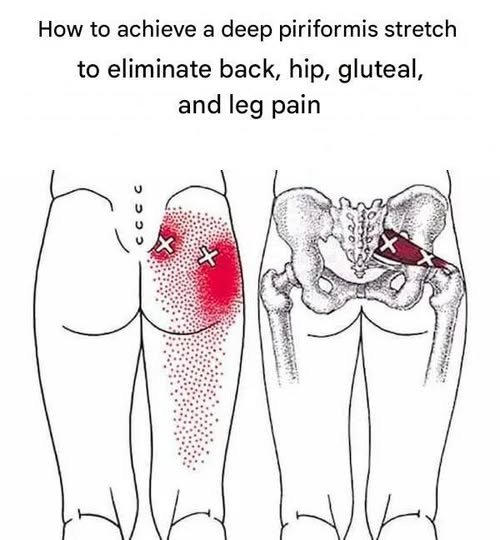
If tightness in your piriformis is driving pain through your lower back, hips, glutes, or down the leg (sciatic-type pain), a deep but safe stretch can be a game changer. The key is slow positioning + relaxed breathing, not forcing range.
Here’s how to stretch the piriformis effectively and deeply without aggravating it 👇
Why the piriformis causes so much pain
The piriformis is a small muscle deep in the buttock that sits right over the sciatic nerve. When it tightens or spasms, it can:
- Compress the sciatic nerve
- Refer pain into the hip, glute, hamstring, or calf
- Mimic disc or low-back pain
🔥 The most effective deep piriformis stretch (supine figure-4)
Step-by-step:
- Lie on your back, knees bent, feet flat
- Cross your right ankle over your left knee (figure-4 shape)
- Gently pull your left thigh toward your chest
- Keep your tailbone heavy on the floor
- Relax your shoulders and jaw
How it should feel:
- Deep stretch in the center of the glute
- NO sharp pain, numbness, or tingling
Hold:
- 30–60 seconds
- 2–3 rounds per side
- Breathe slowly through your nose
💡 If it feels mild, pull the supporting leg closer. If it’s too intense, back off slightly.
🧘♂️ Seated piriformis stretch (great for work or travel)
- Sit tall on a chair
- Place ankle over opposite knee
- Hinge forward at the hips (don’t round your back)
- Press gently on the raised knee only if pain-free
Hold 30–45 seconds.
🐦 Advanced stretch: Reclined pigeon (gentler than floor pigeon)
- Same as the supine version, but angle the crossed knee slightly outward
- Excellent if floor pigeon hurts your knees or back
🚫 What NOT to do
- Don’t bounce
- Don’t stretch into sciatic pain
- Don’t force the knee downward
- Avoid aggressive foam rolling directly on the nerve
Pain = irritation, not progress.
🔁 How often for relief
- Daily if you have symptoms
- Best times: after walking, workouts, or long sitting
- Pair with light movement (walking beats bed rest)
⚠️ When stretching isn’t enough
If pain:
- Shoots sharply down the leg
- Comes with numbness or weakness
- Doesn’t improve after 2–3 weeks
…it may involve disc irritation or nerve root compression and should be evaluated.
Bonus tip 💡
Piriformis tightness often comes from:
- Prolonged sitting
- Weak glutes
- Limited hip rotation
Stretching works best when combined with gentle glute activation (bridges, clamshells).
If you want, I can:
- Build a 5-minute daily piriformis relief routine
- Help you tell piriformis pain from true sciatica
- Show nerve-friendly stretches that won’t flare symptoms
- Customize this for runners, desk workers, or gym training
Just tell me what you need 💛