
Popular Mechanics

The Week

SciTechDaily

ScienceDaily

The Times of India
🦷 1. Human Trials of a Tooth-Regrowing Drug
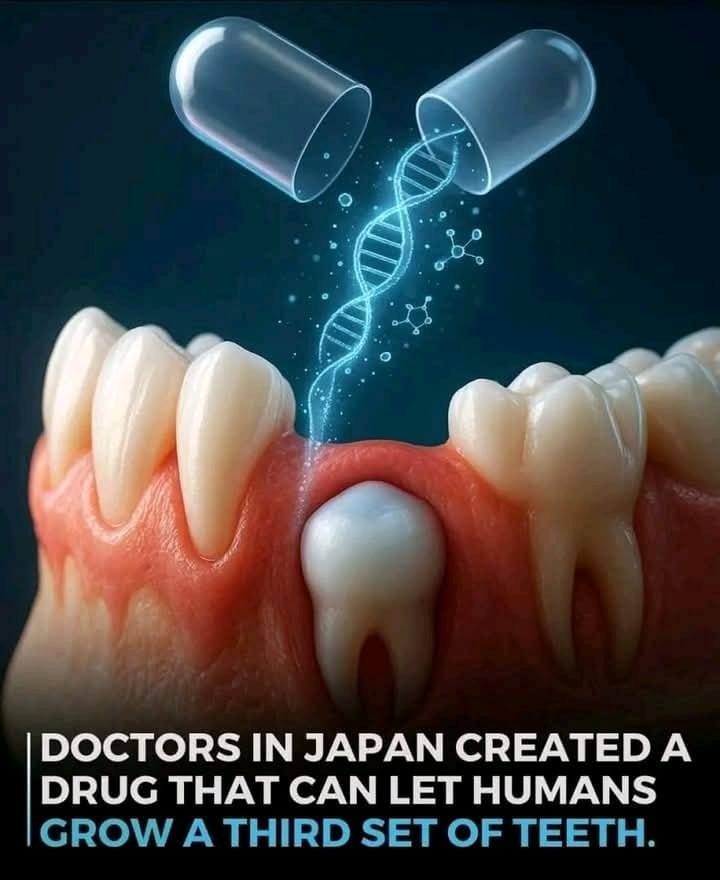
Japanese researchers have started human clinical trials on a drug designed to stimulate natural tooth regrowth by activating dormant biological pathways. This drug targets key genes involved in tooth development, such as USAG-1 (also called SOSTDC1), which normally suppresses tooth growth. The idea is to unlock a “third set” of teeth that may already exist in a latent form beneath the gums.
-
These trials began in late 2024 / ongoing into 2025, with researchers hoping the drug could eventually become widely available — possibly by around 2030 if things go well.
-
Early studies in animals (mice and ferrets) have shown promising results where new teeth were induced to form.
This approach differs from traditional implants and dentures because it aims to use the body’s own biology to grow a real tooth rather than inserting a mechanical replacement.
🧬 2. Understanding the Science: Genes, Buds, and Stem Cells
Hidden Tooth Buds
Scientists have found evidence that humans might retain dormant buds for a “third set” of teeth — remnants of evolutionary biology. By manipulating certain gene signals, these buds might be triggered to grow new teeth.
Stem Cell Insights
Recent stem cell research has identified the specific populations of cells responsible for forming the tooth root and the supporting bone (alveolar bone). Understanding how these cells differentiate brings researchers closer to orchestrating true tooth regeneration, not just a crown or prosthesis.
This work is critical because fully natural teeth consist of multiple tissue types — enamel, dentin, pulp, periodontal ligament, and root — all of which must form and integrate correctly.
🧪 3. Lab-Grown Teeth & Bioengineered Solutions
Another major avenue of research is lab-grown teeth. Scientists at institutions like King’s College London have developed methods to create environments in which tooth-forming cells can communicate and regenerate tooth structures in the lab.
-
These lab-grown teeth could one day be implanted into a patient’s jaw and function like natural teeth.
-
Unlike current implants, these would be living biological structures with the potential for growth, integration, sensation, and self-repair.
Also coming out of research labs are bioinspired materials like enamel-regenerating gels that could repair damaged tooth surfaces without traditional fillings.
🦷 4. Why This Matters for Dentistry
If these approaches succeed, the future of dental care could be transformed:
✅ Natural Replacement: Lost or damaged teeth could be biologically replaced rather than mechanically restored.
✅ Better Integration: Regrown teeth could bond with nerves and bone, potentially restoring sensation and strength.
✅ Reduced Need for Implants & Dentures: Many current prosthetic solutions might become obsolete.
✅ Fewer Fillings/Root Canals: Stem cell approaches may help regenerate dentin or pulp, reducing conventional restorative needs.
⏱️ Timeline & Challenges
While the science is advancing rapidly, widespread clinical use is still several years away. Many researchers estimate that 2030 or the early 2030s could be when the first commercial tooth-regeneration therapies become available — but real-world approval, safety, scalability, and cost issues remain to be worked out.
✅ Summary
-
Human trials are underway for a drug that could help adults regrow natural teeth.
-
Scientists are uncovering the genetic and stem-cell mechanisms that make tooth regrowth possible.
-
Lab-grown tooth research and new biomaterials could reshape how tooth loss is treated worldwide.
-
If successful, these breakthroughs would mark a major shift in dentistry — moving from mechanical fixes to biological regeneration.
If you want, I can explain how the USAG-1 gene therapy works in more detail or break down the differences between the regrowth drug and lab-grown teeth methods — just let me know!